Electric Inboard vs Outboard Motors: Which Is Right for Your Boat?
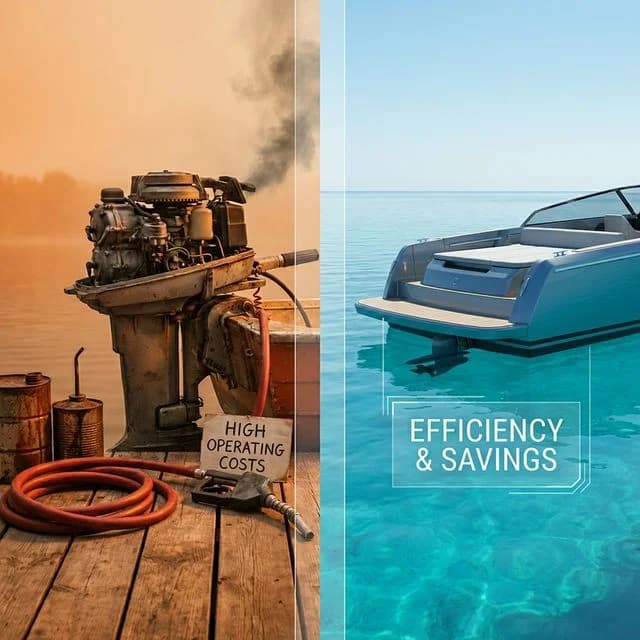
The shift toward electric propulsion is reshaping the boating world, and with it comes one of the most important decisions any boat owner will face: choosing the right motor configuration. The debate over inboard engine vs outboard setups has existed for decades, but electric technology has added an entirely new layer of complexity to the conversation.
Whether you are upgrading an existing vessel or spec'ing out a brand new build, the motor placement you choose will influence everything from performance and efficiency to maintenance costs and resale value. Both configurations have evolved dramatically in the electric era, and the "obvious" choice is rarely as straightforward as it seems.
In this guide, we will break down the real differences between electric inboard and outboard motors, examining the practical trade-offs that matter most to intermediate boaters who already understand the basics. You will walk away with a clear framework for evaluating your specific boating style, hull type, and budget, so you can make a confident, informed decision before you invest in your next electric propulsion system.
How Electric Inboard Motors Work
An electric inboard motor sits entirely within the hull of the boat, mounted near the vessel's center of gravity to optimize weight distribution and stability underway. Power transfers to the propeller through a drive shaft that exits the hull below the waterline, leaving the transom completely unobstructed. This architecture closely mirrors traditional diesel inboard layouts but replaces the combustion engine with an electric motor and integrated battery bank. The practical trade-off is meaningful: while the transom stays clean and accessible, the motor and its supporting systems occupy interior volume that might otherwise serve as storage or cabin space.
Purpose-Built Products for 2026
The most relevant electric inboard options available today come from ePropulsion, whose dedicated inboard lineup reflects the growing maturity of this segment. The ePropulsion I-Series is purpose-built for both recreational and commercial vessels, distributed through professional marine channels in North America. The ePropulsion H-Series targets larger and higher-duty applications, with explicit commercial positioning for continuous-operation environments such as water taxis and passenger ferries. Both products reflect the reality that electric inboard technology has matured beyond the DIY conversion stage into a structured, professionally supported market.
System Planning and Environmental Protection
Because the motor is fully sealed within the hull, electric inboards gain inherent protection from saltwater spray and wave exposure that outboard-mounted motors must manage externally. However, that enclosed placement introduces three interconnected engineering demands: ventilation to prevent heat buildup, deliberate battery placement for weight balance and maintenance access, and an adequate cooling strategy for sustained load operation. As the ePropulsion inboard motor guide notes, these systems require careful planning before installation rather than adjustments after the fact.
Power Output, Application Fit, and Installation Reality
Inboard configurations allow the use of larger-diameter, slower-turning propellers, which are inherently more efficient for displacement and semi-displacement hulls over extended distances. This makes electric inboards the logical choice for long-range cruising, heavy sailboat auxiliary drives, and commercial vessels running continuous duty cycles. Installation demands reflect this higher capability: shaft log fitting, motor bed fabrication, and full battery management system integration all require professional marine expertise in most cases, increasing upfront investment. The result, however, is a noticeably cleaner vessel profile, better noise and vibration characteristics for passengers, and a propulsion system that is deeply integrated into the boat rather than bolted to its exterior.
How Electric Outboard Motors Work
Unlike their inboard counterparts, electric outboard motors mount entirely outside the hull, clamping or bolting directly to the transom with no structural hull modification required. This external configuration makes them the most practical upgrade path for existing boat owners exploring electric propulsion. A conventional inboard conversion demands shaft tunnels, rudder integration, and significant hull engineering work; an outboard retrofit, by contrast, can often be completed in an afternoon. For anyone comparing inboard engine vs outboard options from a practical standpoint, this installation simplicity alone makes outboards the default starting point for recreational boaters.
Power Range and Leading 2026 Models
The electric outboard market has matured considerably, and 2026 marks a turning point in performance capability. New 2026 electric outboard models are delivering greater range and planing-capable speeds that were previously associated only with combustion or large inboard electric drives. The ePropulsion Spirit 2 and kLite 750, both designated new for 2026, represent the leading edge of consumer-accessible electric outboard technology. Torqeedo's Travel and Cruise lines round out the upper tier of the market. Together, ePropulsion and Torqeedo dominate comparison content, with head-to-head shootout videos accumulating hundreds of thousands of views across YouTube. According to EMO Electric's 2026 buyer's guide, the market now spans four distinct power tiers: sub-1 kW kayak motors, 1 to 3 kW mid-range models, 3 to 10 kW performance outboards, and units exceeding 10 kW targeting mid-size vessels.
Space, Serviceability, and Practical Advantages
Because the motor lives entirely outside the hull, electric outboards eliminate every internal drivetrain component: no motor compartment, no shaft log, no rudder assembly. On smaller fishing boats and recreational day boats where interior cubic footage is genuinely limited, this translates into usable storage and cockpit space that an inboard configuration simply cannot offer.
Serviceability is another area where outboards hold a clear structural advantage. An electric outboard is a removable unit; it unclamps from the transom and can be transported to a dealer, shipped for warranty repair, or inspected by a technically inclined owner using manufacturer-provided tutorials. Inboard electric motors, fixed within the hull, require on-site professional access regardless of the fault. For boaters who value independence and lower long-term service costs, this distinction is significant. Exploring real-world installation and configuration decisions from experienced boat owners illustrates how consistently these practical factors drive the choice toward outboards for recreational applications.
POD Drives: The Emerging Third Option
Beyond the traditional binary of inboard versus outboard sits an increasingly relevant third category: the POD drive. POD drives mount beneath the hull in a self-contained underwater housing, sharing the inboard's low center of gravity and space-efficient interior footprint while remaining externally accessible for inspection and service, much like an outboard. The result is a configuration that captures meaningful advantages from both worlds without inheriting their core compromises.
The electric marine segment has proven particularly receptive to this form factor. Because electric POD drives carry no exhaust routing requirements, no fuel lines, and no combustion cooling intake, designers gain packaging freedom that simply does not exist with diesel or gasoline alternatives. ePropulsion's current POD drive lineup includes two product families: the POD Drive Evo, covering 3 to 10 HP equivalent, and the higher-output POD Drive eSSA, rated at 20 to 30 HP equivalent. With six outboard models and two inboard series rounding out their 2026 catalog, ePropulsion treats POD drives as a deliberate, standalone propulsion category rather than a niche offshoot.
From a maneuverability standpoint, POD drives offer a meaningful advantage over fixed-shaft inboards. Because the unit can vector thrust directionally without a separate rudder assembly, low-speed control improves considerably, making marina docking and close-quarters maneuvering more predictable. This characteristic makes the POD configuration especially practical for catamarans, pontoon boats, and flat-bottomed commercial vessels where running a traditional through-hull shaft is geometrically impractical or structurally disruptive.
Buyers evaluating POD drives in 2026 should approach the category with realistic expectations around availability. The SKU depth for POD drives remains thin relative to outboard and inboard categories, and dealer service networks for POD-specific maintenance are still developing across North America and Europe. Factor extended lead times into procurement planning, and confirm local service support before committing to a POD-based build or repower.
Head-to-Head Comparison: Inboard vs Outboard vs POD Drive
With the foundational understanding of how each configuration operates now established, putting them side by side reveals clear winners across specific use cases rather than a single universal answer.
Installation Complexity
The gap between configurations is widest at the installation stage. Electric outboards require zero hull modification and can typically be mounted by a competent owner in a matter of hours, with no shaft work, no hull penetrations, and no specialized sealing required. Inboard electric motors sit at the opposite extreme: professional installation is standard practice, involving custom propeller shaft alignment, underwater seal fitting, and careful battery cable routing through the bilge. This labor alone commonly adds several thousand dollars to the project cost before the motor itself is even considered. POD drives occupy a middle ground, requiring hull mounting hardware and underwater fairing work, but avoiding the full complexity of a traditional inboard shaft installation.
Space and Layout Tradeoffs
Outboards consume no interior volume whatsoever, a genuine advantage on smaller boats where every cubic foot of cabin or cockpit space matters. The tradeoff is transom real estate: an outboard bracket reduces usable stern seating and can limit cockpit layout flexibility. Inboards reclaim the transom entirely, opening up swim platforms and seating arrangements, but that gain comes at the direct cost of bilge and cabin space claimed by the motor housing, battery banks, and associated plumbing. POD drives offer a hybrid outcome, freeing both the transom and the interior to varying degrees depending on mounting depth and hull design.
Maneuverability by Environment
No single configuration dominates across all water conditions. POD drives, with their 360-degree thrust vectoring capability, deliver the tightest control in congested marina environments where precise low-speed positioning is critical. Electric outboards match that agility at the transom and add a shallow-water advantage: the ability to tilt the motor clear of the bottom in depths that would ground an inboard or pod installation. Inboards, with their centralized weight distribution, favor steady straight-line performance at cruising speeds rather than tight-quarters maneuvering.
Power Range, Cost, and Compliance
The 2026 electric outboard market currently offers the broadest horsepower selection of the three configurations, ranging from 1.5 HP models suited to tenders and kayaks up through 60+ HP performance units. A detailed breakdown of available electric propulsion options by configuration confirms that inboard and pod drive selections remain narrower by comparison. On total cost of ownership over a five-year horizon, outboards typically win for recreational buyers through lower installation and maintenance costs. Inboards can justify their higher upfront investment in commercial duty-cycle applications where continuous runtime efficiency generates meaningful operational savings. On zero-emission zone compliance, all three configurations are equivalent since all are fully electric, producing no CO2 or hydrocarbon discharge. That said, form factor does carry some weight in European port contexts, where hull configuration and external motor presence can influence marina berth eligibility and mooring regulations in certain protected zones.
Which Configuration Fits Your Boat Type?
Matching the right propulsion configuration to your specific vessel type eliminates guesswork and prevents costly mismatches between motor placement and hull design. Each boat category carries its own structural constraints, usage patterns, and performance priorities that make one configuration objectively better suited than others.
Pontoon Boats
Pontoon boats present a genuinely flexible platform when it comes to propulsion. POD drives are a strong architectural fit for twin-pontoon hulls, where the underhull space between the logs offers clean, practical mounting geometry without interfering with the deck platform above. That said, outboards remain the dominant choice across the pontoon market for straightforward reasons: lower upfront cost, simpler installation, and a broad aftermarket support network. Entry-level pontoons in the $21,000 range almost always ship with outboard configurations, while premium performance builds increasingly explore POD options for cleaner aesthetics and improved handling at higher speeds.
Center Consoles and Fishing Boats
Center consoles and dedicated fishing boats represent perhaps the clearest case for outboard propulsion across any vessel category. The configuration keeps the entire deck uncluttered for casting, rigging, and movement, while the ability to tilt and trim the motor in shallow water is operationally essential for flats fishing and nearshore work. Manufacturers like Sportsman Boats have built their entire lineup around outboard power, citing performance, versatility, and maintenance convenience as the core rationale. Center consoles now range from 17 to 65 feet, and across virtually that entire size spectrum, outboard remains the industry standard. For electric builds in this category, the same logic applies: electric outboards slot directly into existing transom mounting systems with minimal modification.
Day Cruisers and Cabin Cruisers
Larger cruising vessels shift the calculus meaningfully. On boats exceeding 25 feet, an inboard electric motor and its associated battery bank can be integrated into the hull without consuming livable space, particularly when the layout includes a dedicated engine compartment. Cabin cruisers with enclosed accommodations, a galley, and sleeping berths benefit from the clean interior lines that inboard placement preserves. The transom remains free for swim platforms and boarding ladders, which matters considerably on vessels designed for extended stays on the water. For a practical overview of how boat type influences these decisions, MarineMax's boat type comparison guide offers useful framing across twelve distinct recreational categories.
Commercial Vessels: Ferries, Water Taxis, and Workboats
Commercial passenger vessels operate under fundamentally different constraints than recreational boats. Ferries and water taxis run continuous-duty cycles that demand propulsion systems rated for sustained output rather than peak sprint performance. Electric inboard and POD configurations satisfy this requirement while keeping passenger deck areas free of motor hardware. Workboats and utility vessels follow similar logic; sustained torque output and structural integration into a rugged hull matter far more than the portability advantages that outboards offer in recreational contexts. Commercial marinas servicing these fleets typically maintain the specialized infrastructure needed for inboard motor service, making professional maintenance less of a logistical burden than it would be at a remote recreational anchorage.
eFoils and Personal Watercraft
At the opposite end of the size spectrum, eFoils and compact personal watercraft operate under hard weight and dimensional constraints that eliminate inboard configurations entirely. The integrated pod-style motors used in eFoils from brands like Lift Foils and Fliteboard are engineered specifically around minimal mass and hydrodynamic compactness, delivering propulsion through a sealed underwater housing that doubles as the structural mast connecting board to foil. Even small electric outboards must be carefully spec'd against hull weight limits in this category. For buyers evaluating personal watercraft propulsion, Hurricane Boats' inboard vs. outboard buying guide provides a helpful grounding in how propulsion form factor shapes the overall ownership experience across vessel sizes.
Total Cost of Ownership: What You Will Actually Pay
Price comparisons between electric inboard and outboard systems reveal a gap that extends well beyond the sticker price. Mid-range electric outboards in 2026, including models like the ePropulsion Spirit 2 and kLite 750, sit in a purchase range of roughly $1,000 to $5,000 depending on thrust rating and battery configuration. Electric inboard systems from the ePropulsion I-Series and H-Series occupy a noticeably higher price bracket, reflecting the additional engineering involved in waterproofing, shaft integration, and hull-compatible mounting hardware. For buyers operating on a defined budget, that upfront delta alone can shift the decision before any other variable enters the calculation.
Installation: Where the Real Cost Gap Opens
Installation costs represent the single largest differentiator in total cost of ownership between the two configurations. A bolt-on electric outboard typically requires nothing more than a transom bracket, a battery connection, and basic hardware totaling under $200 for a competent DIY installation. Electric inboard systems are a fundamentally different project. Professional installation commonly runs between $2,000 and $8,000 depending on hull complexity, shaft alignment requirements, and the scope of battery system integration. Labor-intensive tasks such as through-hull fitting, motor bed construction, and electrical routing require skilled marine electricians and, in many cases, a haul-out. Reviewing electric outboard running costs in real-world contexts confirms that accessible mounting and simple wiring are among the strongest recurring arguments for the outboard format among recreational buyers.
Five-Year Maintenance and Battery Lifecycle
Maintenance costs over a five-year horizon consistently favor outboards for recreational boaters. Servicing is largely DIY, replacement parts are widely stocked through major marine retailers, and there is no need for haul-outs to access the motor. Inboard systems, by contrast, often require professional service for even routine inspections, with haul-out fees adding meaningful cost every cycle. Battery replacement runs approximately every five to ten years depending on usage intensity. Because outboard battery packs are modular and externally accessible, swapping them out is straightforward and comparatively affordable. Reconfiguring an inboard battery bank is a more complex undertaking, often requiring the same professional coordination as the original installation.
Commercial operators should weigh this analysis differently. Ferries and water taxis running sustained high-load cycles can extract efficiency advantages from electric inboard systems that accumulate meaningfully over ten or more years of operation. The fixed costs are higher, but the per-hour energy efficiency at sustained loads can offset them. Quantifying that ROI requires real usage data, and eBoatDirectory's ROI calculator gives commercial operators a structured way to model those numbers against their specific operational profiles before committing to either configuration.
Electric-Specific Maintenance: What Actually Differs
Switching to electric propulsion reduces maintenance burden significantly, but configuration still determines how and where that work happens, and the differences are more practical than theoretical.
Waterproofing and IP Ratings
Electric outboards like those in the ePropulsion Spirit and Navy Evo series are engineered from the ground up to withstand direct water exposure, with marine-grade sealing rated for submersion during normal operation. Inboard electric motors face a different environmental threat: bilge moisture, condensation, and incidental spray rather than immersion. This distinction matters because an inboard motor's IP rating reflects factory specs tested under controlled conditions, while real-world protection depends heavily on installation quality, specifically how well cable penetrations are sealed and whether compartment ventilation prevents moisture accumulation. A poorly installed inboard can compromise a motor's rated protection regardless of what the spec sheet states.
Battery Access and DIY Serviceability
Battery accessibility represents one of the most consequential practical differences between configurations. Outboard electric systems typically pair with batteries stored in cockpit boxes or integrated cases that owners can inspect, swap, or charge without tools. Inboard battery banks, by contrast, are generally located under floorboards or inside sealed hull compartments, meaning routine inspection or replacement often involves partial disassembly and, in some cases, boatyard access or specialized labor.
DIY serviceability broadly favors outboard configurations. Most outboard owners can independently manage firmware updates, anode inspections, connection checks, and seasonal de-winterization without professional involvement. Inboard electric motors, much like their combustion equivalents, remain enclosed within the hull, and accessing them for anything beyond basic diagnostics may require specialized tools or a certified service center.
Corrosion and Long-Term Servicing
Saltwater corrosion affects both configurations through different attack vectors. Outboard lower units require consistent sacrificial anode replacement and fresh-water flushing after every saltwater outing. Inboard systems carry risk at shaft seals, stuffing boxes, and through-hull fittings, where slow leaks can go undetected for extended periods before causing expensive damage.
The positive news applying to both configurations equally: electric drivetrains eliminate the most frequent combustion service tasks entirely. No oil changes, no spark plugs, no fuel system maintenance. That said, annual inspection of electrical connections, cooling passages, and motor seals remains non-negotiable regardless of motor placement, and inboard installations demand particular attention to bilge environment monitoring given their enclosed operating conditions.
Zero-Emission Zones and Regulatory Drivers
Regulatory pressure on marine propulsion is no longer a distant concern for recreational or commercial buyers. Zero-emission zones are expanding at a measurable pace across both continents, and the bodies of water affected range from alpine lakes in Switzerland and Germany to inland rivers in the Netherlands, coastal marinas in California, and tidal zones along the UK coastline. California's Air Resources Board passed landmark commercial harbor craft amendments in 2022, with CARB projecting an 89% reduction in diesel particulate matter and a 54% reduction in nitrogen oxides by 2035, protecting more than 22 million residents living within 50 miles of the California coast. Short-run ferry operators covering routes under three nautical miles were required to transition to fully zero-emission propulsion by January 1, 2026, making electric inboard and outboard configurations an immediate operational necessity rather than a long-term option.
All three electric configurations, including inboard, outboard, and POD drives, satisfy zero-emission requirements by definition since they produce no direct exhaust emissions at the point of use. However, compliance is not automatically guaranteed for every vessel in every regulated zone. Certification requirements vary by hull class, vessel displacement, operating range, and installation method, and a configuration that qualifies on one inland waterway may require additional documentation or inspections in another jurisdiction. Buyers operating in regulated regions should verify local requirements with the relevant authority before purchase rather than assuming any electric motor automatically clears all applicable rules.
The EU's push toward carbon-neutral inland waterway transport is accelerating commercial fleet electrification with particular urgency for passenger ferries and water taxis operating under public concession agreements in emission-sensitive corridors. These operators face both regulatory deadlines and contractual renewal pressures that make the configuration decision a compliance issue, not merely a preference.
Future-proofing your investment means evaluating not only which configuration fits your hull today but whether batteries, software updates, and spare parts will be available in your region through 2032 and beyond. The global inboard engine market is valued at USD 1.73 billion in 2025 and forecast to reach USD 2.71 billion by 2032 at a CAGR of 6.6%, with electric and hybrid subsegments growing fastest. Regional service network depth, however, still varies considerably between metropolitan and rural areas on both continents.
Buyers navigating this landscape can use eBoatDirectory's directory and buying guides to filter available electric models by region, vessel type, and power output, streamlining the search for configurations that match both operating environment and applicable regulatory requirements.
How to Choose: A Practical Decision Framework
The right configuration comes down to four practical variables: boat size, use case, budget, and how much complexity you are willing to manage. Mapping each buyer profile to those variables cuts through the noise quickly.
Recreational buyers with boats under 25 feet should default to an electric outboard in the majority of cases. Lower purchase cost, zero hull modification, and genuinely DIY-friendly maintenance remove most of the risk from a first electric propulsion purchase. The 2026 model landscape from brands like ePropulsion and Torqeedo is broader than it has ever been, spanning from sub-1kW models suited to tenders and inflatables through high-output options capable of powering center consoles and runabouts in the 15 to 25 foot range. That selection depth matters because it means buyers can match output to hull displacement precisely rather than compromising.
Buyers focused on maneuverability, particularly those docking regularly in tight marinas or navigating confined inland waterways, should give serious consideration to POD drives. Pontoon and catamaran hulls are especially well suited to POD mounting geometry, and the 360-degree thrust vectoring that POD drives provide eliminates the stern-swinging behavior that makes conventional prop configurations frustrating in close quarters. POD installation does require more technical confidence than transom-mounting an outboard, so buyers should factor in professional installation costs when comparing options.
Commercial operators running ferries, water taxis, or charter vessels should resist the temptation to select a configuration before completing a full total cost of ownership analysis. Duty cycle hours, battery sizing requirements, and regional availability of certified service technicians can shift the economics significantly between an electric inboard system and a POD drive arrangement.
Budget-constrained buyers will find outboards the most accessible entry point in nearly every scenario. Entry-level electric outboards from established brands are available below $2,000, and a functioning secondary market for tested units is now active through specialist retailers, reducing first-purchase risk further.
Buyers still uncertain after working through these variables can browse eBoat Directory's multi-category electric vessel directory, which organizes listings by boat type, motor configuration, and manufacturer across North America and Europe. Cross-configuration comparison becomes practical without the friction of contacting multiple manufacturers or dealers separately.
Conclusion: Three Configurations, One Right Answer for Your Boat
The core tradeoffs across this comparison are clear and consistent. Electric outboards lead on accessibility, affordability, and DIY-friendly maintenance, making them the default choice for recreational boaters, anglers, and anyone operating smaller hulls. Electric inboards deliver sustained power output, seamless hull integration, and the torque characteristics that larger vessels and commercial operators require. POD drives occupy a precise middle ground, offering 360-degree thrust vectoring and superior maneuverability for vessels where docking precision or tight waterway navigation is a priority.
What has changed fundamentally in 2025 and 2026 is that this decision no longer belongs to the combustion era. Mature electric versions of all three configurations are available now from established manufacturers, with new product launches confirming that the electric marine market is expanding toward its projected 2032 growth horizon at an accelerating pace.
Buyers who act now position themselves ahead of tightening zero-emission zone regulations and gain early compatibility with the charging infrastructure spreading across North American and European marinas. To move forward, browse eBoatDirectory's electric vessel directory to filter models by configuration, use the ROI calculator if you are evaluating commercial applications, and consult the electric outboard buying guides to shortlist specific units matched to your hull and horsepower requirements.
Stay in the Loop
Get weekly updates on the latest electric boats, industry news, and exclusive insights.