Electric Workboat TCO: A Five-Year Model for US Commercial Operators
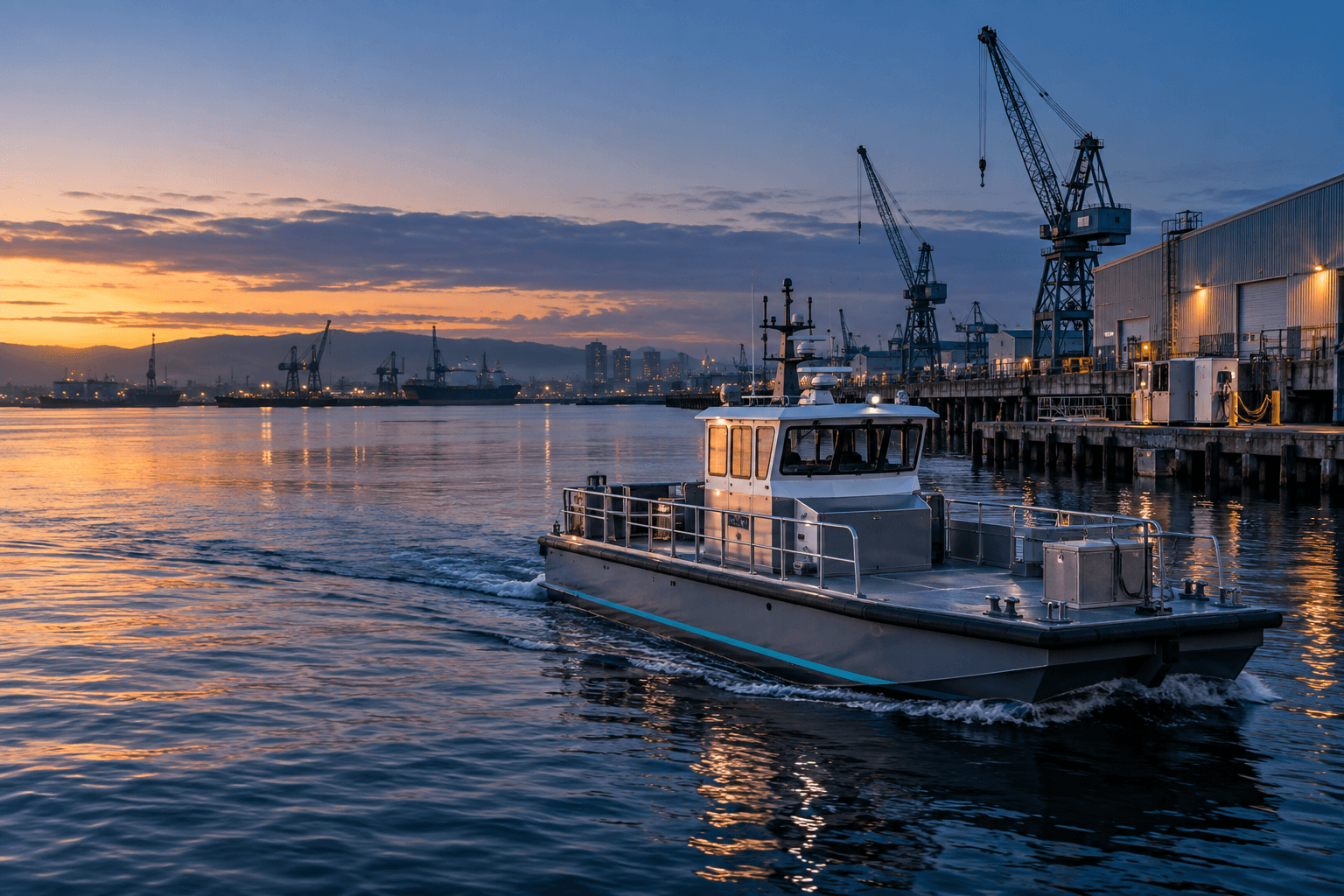
An electric workboat can look compelling on fuel and maintenance alone—and disappointing once dock upgrades and residual value are included. The difference is not a single universal saving. It is the result of a few inputs that every fleet can test: duty cycle, fuel price, electricity tariff, charging infrastructure, vessel quote and resale assumption.
This is a transparent five-year planning model for a mid-size US harbor workboat. It is not a vessel quote, tax opinion or operating guarantee. It shows why a high-utilisation route can reach parity in four years, while the same vessel on a seasonal route may not close the gap within five.
The short answer
In the base case, the electric vessel starts with a $450,000 purchase-price premium. At 240 operating days per year, it recovers that premium through lower energy and maintenance costs, reaches cumulative-cost parity in year four, and is $258,000 ahead by year five.
That result becomes less certain when two often-missed costs are added:
- A $150,000 shore-power and grid-upgrade bill moves parity to year five and reduces the five-year advantage to $108,000.
- Crediting the diesel boat with a 45% resale value at year five puts the base case $57,000 behind diesel.
The practical takeaway: electric is most credible where the boat works hard, charging can be installed at a sensible cost, and the operator tests diesel resale rather than treating it as zero.
Why purchase price is only the beginning
Electric workboats usually cost more upfront. For commercial procurement, however, a purchase comparison alone misses the categories that change over a five-year operating period: fuel or electricity, maintenance, charging infrastructure, and end-of-life or resale value.
The model below holds the vessel type constant and changes only the powertrain. All figures are rounded to the nearest $1,000. They are planning assumptions that should be replaced with your own fuel invoices, utility tariff, dock assessment and builder quote.
Base-case assumptions
| Input | Diesel workboat | Electric workboat |
|---|---|---|
| Acquisition cost | $700,000 | $1,150,000 |
| Operating days per year | 240 | 240 |
| Energy use per operating day | 250 gal | 4,000 kWh |
| Year-one energy price | $4.20/gal, rising 2.5% annually | $0.13/kWh, flat |
| Annual demand charges | — | $15,000 |
| Annual maintenance | $26,500 | $10,000 |
| Base-case infrastructure cost | $0 | $0 |
| Base-case resale value at year five | $0 | $0 |
The 4,000 kWh/day electric input is an energy-equivalence planning estimate, not a metered result. It assumes a diesel workboat consuming 250 gallons per day, a typical diesel drivetrain efficiency of roughly 35%, and charging plus electric-drive losses. A comparable route with logged shore-power data is a far better input.
Five-year cashflow
Cumulative cost includes acquisition, energy and maintenance. The base case excludes grants, charging infrastructure and resale value so that each can be tested separately.
| Year | Diesel cumulative cost | Electric cumulative cost | Electric minus diesel |
|---|---|---|---|
| 1 | $979,000 | $1,300,000 | +$321,000 |
| 2 | $1,263,000 | $1,450,000 | +$187,000 |
| 3 | $1,555,000 | $1,599,000 | +$44,000 |
| 4 | $1,852,000 | $1,749,000 | -$103,000 |
| 5 | $2,157,000 | $1,899,000 | -$258,000 |
The electric vessel begins $450,000 behind. In this scenario, lower energy and maintenance spending closes that gap during year four. The saving is not fixed: lower diesel prices, higher electricity rates, more expensive charging equipment or fewer working days can each reverse it.
The three assumptions that decide the outcome
1. Utilisation
High annual usage gives the lower operating cost time to work. In this model, an electric workboat needs about 150 operating days a year to reach five-year parity when diesel resale is excluded. Once a 45% diesel resale value is included, the threshold rises to about 260 days.
That makes route selection more important than fleet-wide averages. Harbor service, passenger transfer, and other boats with consistent daily work are better candidates than seasonal, standby or lightly used assets.
2. Shore power and grid upgrades
Charging is part of the asset—not an afterthought. A berth may need equipment, cable work, switchgear, demand-management equipment or a utility-side upgrade before the boat can deliver its planned duty cycle.
Every $50,000 added to charging infrastructure removes $50,000 from the electric five-year advantage in this model. At $150,000, parity moves from year four to year five. A site assessment should therefore happen before a vessel specification is finalized.
3. Diesel residual value
Used diesel workboats have an established secondary market; used electric commercial vessels do not yet offer the same depth of comparable transactions. A conservative model can give the electric boat zero terminal value, but it should not quietly give the diesel boat zero as well.
Using a 45% diesel residual value ($315,000 on a $700,000 purchase) changes the base case from a $258,000 electric advantage to a $57,000 deficit. That is a useful reminder that the procurement case should be presented both with and without resale assumptions.
Sensitivity scenarios
| Case | Parity year | Five-year electric margin, no diesel resale | Five-year margin with $315,000 diesel resale |
|---|---|---|---|
| Base: $4.20 diesel, 240 days | 4 | +$258,000 | -$57,000 |
| Base + $100,000 infrastructure | 4 | +$158,000 | -$157,000 |
| Base + $150,000 infrastructure | 5 | +$108,000 | -$207,000 |
| $3.50 diesel, flat price | No parity | -$17,000 | -$332,000 |
| $5.00 diesel, 3% annual increase | 3 | +$526,000 | +$211,000 |
| $5.00 diesel + $150,000 infrastructure | 4 | +$376,000 | +$61,000 |
| 180 operating days | 5 | +$83,000 | -$232,000 |
| 120 operating days | No parity | -$92,000 | -$407,000 |
Positive margins mean the electric vessel has the lower cumulative cost at year five. These are scenario outputs, not a price forecast.
Maintenance and downtime: include them, but do not overstate them
Electric drivetrains avoid oil changes, exhaust-system work and much of the routine service associated with diesel engines. They still require battery-management diagnostics, charging-system inspection, corrosion control, seals and normal hull maintenance.
For this model, annual maintenance is set at $26,500 for diesel and $10,000 for electric. That produces an $82,500 maintenance difference over five years. Those figures should be treated as placeholders until they are checked against your own maintenance history, warranty terms and the builder's service plan.
Downtime may be commercially important, but this model assigns it no dollar value because a defensible workboat-specific dataset is hard to establish. Operators should track unscheduled maintenance days and the operational cost of a missed shift separately.
Treat incentives as upside, not the baseline
The federal tax-credit landscape has changed quickly. The IRS states that the Section 45W qualified commercial clean-vehicle credit is not available for vehicles acquired after September 30, 2025, and that the Section 30C alternative-fuel refueling-property credit is not available for property placed in service after June 30, 2026. Eligibility is fact-specific, and marine assets should not be assumed to qualify for incentives written with other vehicle types in mind. IRS guidance on the 2025 law changes
Build the unassisted case first. Then add a state program, port grant or utility contribution only after its terms are documented. In this model, every $100,000 of awarded funding brings parity forward by roughly eight months near the crossover point.
A practical workflow for a fleet decision
- Assess the berth. Obtain a dock and utility assessment before relying on a vessel range or charging plan. Include all on-site and utility-side costs.
- Model the actual route. Use the route's operating days, speed profile, downtime tolerance and shore-power window—not annual fleet averages.
- Run at least three cases. Compare an unfunded baseline, an awarded-funding case, and each with a reasonable diesel resale value.
- Extend low-use cases. A five-year model may not capture a seasonal asset's economics. If the duty cycle is below 150 days, model seven to ten years and include battery renewal risk.
- Get specialist review before contracting. Tax eligibility, utility demand charges, battery warranty obligations and port requirements are contract-level details, not footnotes.
Bottom line
Electric workboats can reach cost parity with diesel in three to five years on high-utilisation routes. They are a harder financial case for low-use boats, expensive grid connections, or fleets that expect a strong diesel resale value.
The most useful TCO model is not the one with the largest projected savings. It is the one that makes its assumptions visible enough for an operator, lender or board to challenge them—and then replace them with real route, tariff and dock data.
This article is for general information only and is not tax, legal, engineering or investment advice.
Stay in the Loop
Get weekly updates on the latest electric boats, industry news, and exclusive insights.