Gas vs. Electric Boats: What the Operating Costs Reveal
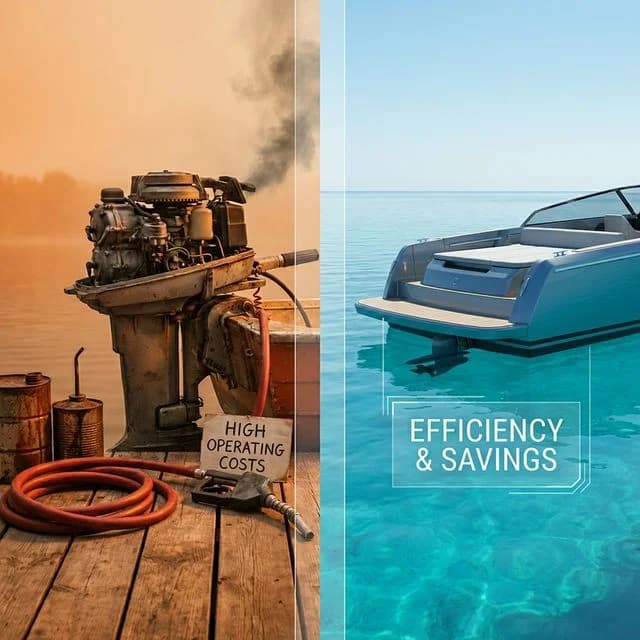
For decades, boat ownership has come with a familiar rhythm: fuel stops, oil changes, impeller replacements, and a seasonal service bill that lands with little surprise. Electric propulsion is challenging that routine — not through novelty, but through arithmetic.
The Fuel Equation
A conventional mid-size gasoline outboard in the 150 to 250 horsepower range can burn 10 to 20 gallons per hour at cruising speed. At recent Ontario fuel prices of roughly $1.70 per litre, that translates to about $65 to $130 per hour in fuel. For an owner logging 75 hours in a season, fuel alone can approach $5,000 to $10,000. Owners who use their boats more frequently, or run at higher speeds, can exceed that range.
An electric boat delivering comparable performance draws from a battery pack measured in kilowatt-hours. Charging costs depend on local electricity rates, but at $0.15 per kWh:
| Recharge Size | Cost per Charge | Typical Use Case |
|---|---|---|
| 40 kWh | ~$6 | Day cruiser, pontoon |
| 100 kWh | ~$15 | Performance boat, full session |
| 226 kWh | ~$34 | High-performance (Arc Sport, etc.) |
Even allowing for higher consumption in performance applications, seasonal energy costs for many recreational electric boats land in the hundreds of dollars rather than the thousands.
Maintenance: Where the Gap Widens
Maintenance amplifies the difference. Gas engines require oil and filter changes, fuel system servicing, spark plugs, impeller replacements, gearcase work, and winterization.
Annual Gas Engine Service Costs
| Service Item | Typical Cost |
|---|---|
| Oil & filter changes | $150–$400 |
| Fuel system / carb service | $100–$300 |
| Spark plugs | $50–$150 |
| Impeller replacement | $150–$350 |
| Gearcase service | $100–$250 |
| Winterization | $250–$600 |
| Annual total | $800–$2,500 |
Over five seasons, routine maintenance alone can exceed the cost of several battery cycles for an electric drivetrain.
Electric Drivetrain Maintenance
Electric propulsion removes many of those variables entirely. There is no oil, no exhaust system, no fuel filters, and fewer moving parts. Service intervals stretch longer. Diagnostics often center on software and battery health rather than mechanical wear.
The result is a lower baseline cost structure and fewer seasonal surprises.
The Five-Season Comparison
The long-term ownership picture also includes secondary effects. Electric systems operate with less vibration and heat. Reduced mechanical stress can translate into fewer hardware issues across the boat. While those savings are difficult to isolate on a spreadsheet, they factor into lifecycle cost.
| Cost Category | Gas (5 Seasons) | Electric (5 Seasons) |
|---|---|---|
| Fuel / Energy | $25,000–$50,000 | $1,500–$5,000 |
| Routine Maintenance | $4,000–$12,500 | $500–$2,000 |
| Winterization | $1,250–$3,000 | $0–$500 |
| Unplanned Repairs | $1,000–$5,000 | $200–$1,000 |
| Total Operating Cost | $31,250–$70,500 | $2,200–$8,500 |
Estimates based on 75 hours/season, 150–250 HP gas outboard vs. comparable electric. Individual results vary by usage, location, and model.
Where Gas Still Wins
None of this eliminates the advantages of gasoline in certain use cases. Offshore range, rapid refueling, and established service networks continue to anchor gas propulsion in blue-water and high-distance applications. Electric boats, by contrast, align with inland lakes, regulated waterways, and day-use profiles where range demands are predictable and charging access is reliable.
The Break-Even Question
The central question for most buyers is not ideology but break-even timing. The inputs that matter most:
- How many hours per season?
- What is the local fuel price?
- What is the marina electricity rate?
- How much is spent on annual maintenance?
- Over how many years will the boat be held?
Those inputs determine whether cost parity arrives in three seasons or seven. They also clarify when operating savings outweigh an initial purchase premium.
Owners considering the shift can run a side-by-side comparison using the operating calculator on the eBoat Directory, which models fuel, electricity, and maintenance variables based on individual usage patterns: Try the Cost Calculator →.
The Bottom Line
Electric propulsion will not replace every gas engine on the water. But when operating costs are examined over a multi-year horizon, the gap between the two systems is no longer marginal. It is structural.
Ready to explore your options? Browse our full directory of electric boats →
Stay in the Loop
Get weekly updates on the latest electric boats, industry news, and exclusive insights.