The Rise of Marina Demo Days for Electric Boats
Electric boats have a spec-sheet problem.
The numbers matter. Battery capacity matters. Motor output matters. Range matters. Charging time matters. But none of those numbers answer the first question most boaters have when they step aboard:
What does this feel like on my water?
That question is pushing more electric-boat sales activity toward marinas, waterfront shows, sea trials, and small demo days. A booth can start the conversation. A ride from the dock can close the gap between interest and trust.
The shift makes sense. Electric boats ask buyers to rethink old habits. There is no idle rumble. Throttle response comes at once. Docking sounds different. Range depends on speed, load, wind, current, and the trip home. Charging depends on the marina, the slip, the outlet, and the owner’s routine.
You cannot settle those questions from a brochure.
The dock tells the truth
A marina demo day strips away the showroom mood. The boat has to work in a real place, with bumpers, lines, current, other boats, wakes, and a human at the helm who may be new to electric propulsion.
That is where the category gets interesting.
At Electrika 2026, the organizers describe a fleet of showboats on the water at Brinklow Waterside & Marina, built around electric narrowboats, electric propulsion equipment, and owner experience. That is a better format for this market than a static stand in a convention hall. A canal owner can hear the boat, feel the low-speed control, ask another owner about battery use, and picture the charging routine at a home mooring.
The same pattern shows up at larger shows. The Cannes Yachting Festival is spread across Vieux Port and Port Canto and says visitors may have a chance to take the helm during sea trials. Cannes also runs an Innovation Route that includes propulsion systems and alternative energies. For electric boats, that water access matters. A test ride turns “innovative propulsion” into a hull leaving the quay.
This is why demo days should not be treated as a side event. For electric boats, the demo is the product story.
Noise is the first surprise
Most people expect an electric boat to be quiet. The test ride still changes their view.
Noise on a boat is not one sound. It is the engine, vibration through the deck, exhaust note, gear whine, water slap, voices raised over the cockpit, and the thud of wakes. Remove the engine and the whole boat changes. People speak at a normal level. Dock staff can give directions without shouting. Passengers notice birds, water, and wind.
Candela sells this in plain language: its leisure boats are framed around a quiet, smooth electric experience, and the site invites prospects to book a test drive. That call to action matters. Candela’s hydrofoil story is hard to explain with a number. Once the hull rises, the buyer feels the change in drag, wake, and motion.
That is hard to unfeel.
Acceleration needs context
Electric motors make torque from the first turn. That sounds simple until someone drives the boat.
On a demo ride, acceleration is not a horsepower debate. It is a control question. Does the boat leave the dock with clean response? Can the driver make small moves without lurching? Does the power feel useful with passengers aboard? Can the boat pull a rider, climb on plane, or hold speed without drama?
Arc is blunt about this. Its demo page says the Arc Sport is touring the United States and Canada. The form asks for contact details and location, then routes prospects into a ride. Arc’s site points to quiet power and instant torque for towing and heavy-duty work. Those claims need water. A wake boat buyer wants to feel the pull. A center-console buyer wants to feel the pickup with people and gear aboard.
Electric acceleration looks good in a video. It makes sense from the helm.
Docking is where trust forms
Many buyers care less about top speed than the last thirty feet into the slip.
Electric drive changes that moment. There is no engine noise to mask mistakes. There is no shift clunk. Throttle inputs can feel direct. Some systems add bow or stern thrusters, joystick controls, or software assists. Some use outboards. Some use pods. Some use foils that sit below the boat and change the way a captain thinks about shallow water, lifts, or debris.
A demo day gives the buyer a chance to ask awkward questions:
- Can I dock this in a crosswind?
- What happens if I tap reverse?
- How much prop wash do I get?
- Can my partner handle it?
- Will this fit my lift?
- Where does the charging cable go?
These are not minor questions. They decide whether the boat fits a life.
Range confidence comes from the trip, not the headline
Range is the topic that turns a casual shopper into a skeptic.
Electric range claims can be true and still be misunderstood. A boat that can cover a long distance at a slow cruise may drain its pack in less time at high speed. A pontoon at cocktail pace, a foiling commuter, and a wake boat with ballast do not use energy in the same way.
A test ride lets the buyer watch the display while the boat runs. They can see battery state, speed, power draw, and estimated distance. They can see what happens when the driver pulls back from a fast run to a cruise. The lesson lands fast: speed costs energy, and small throttle changes can add margin.
That is why the best demo format includes more than a lap around the harbor. It should include:
- A low-speed section near the dock
- A cruise section
- A short acceleration run
- A return leg with the range display in view
- A conversation about the owner’s normal route
The buyer does not need a lab test. They need a mental map: from this marina to that beach, back to the slip, with reserve.
Charging access is part of the ride
Charging is where marina demo days beat boat-show booths.
An electric boat is not one purchase. It is a boat plus a charging habit. A buyer needs to see the plug, the shore-power pedestal, the cable path, the charging rate, and the plan for shared slips. They need to know whether an overnight charge fits their use. They need to know what changes if the boat sits on a lift, on a trailer, or in a dry stack.
The dock makes that concrete.
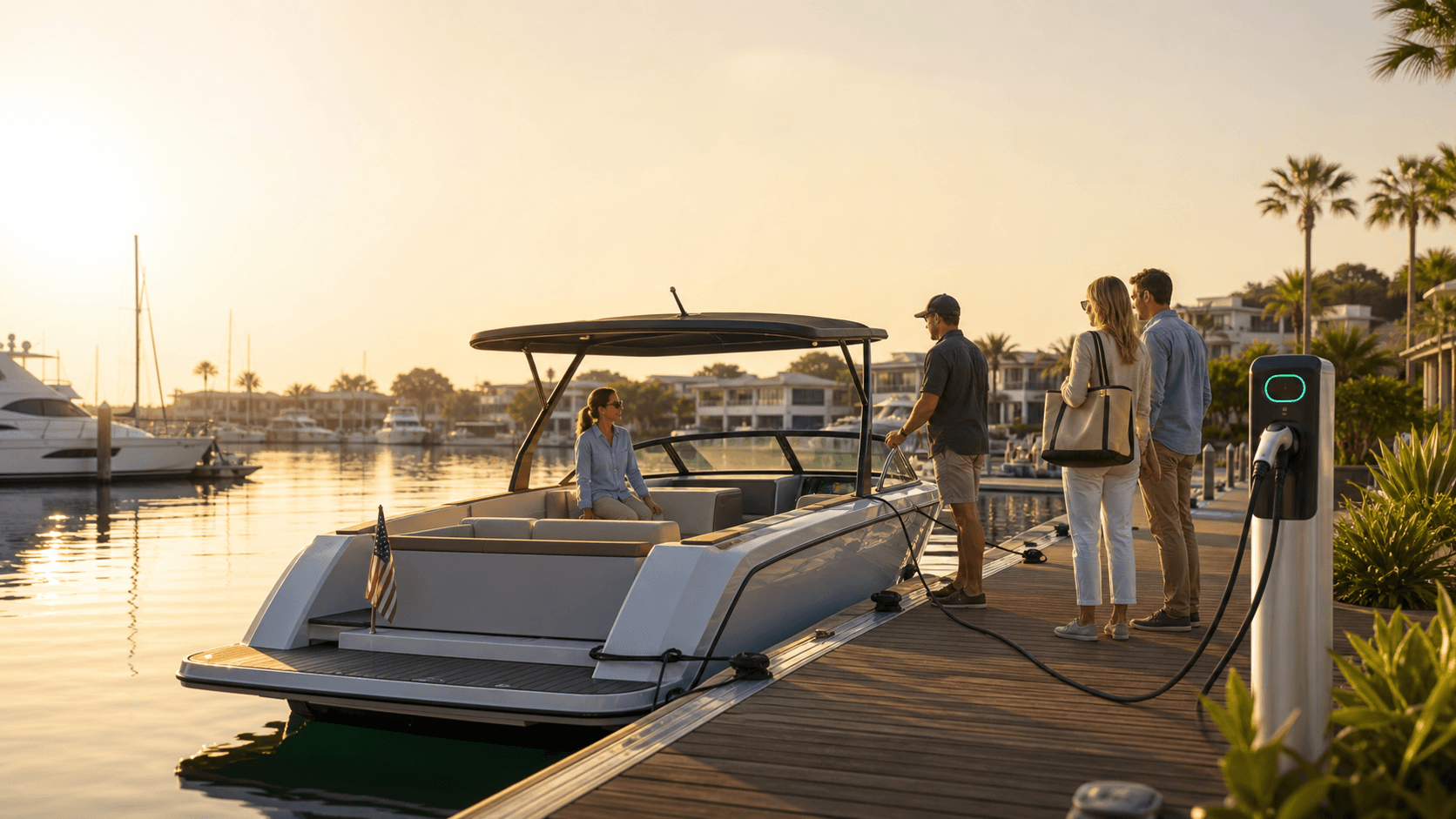
At a marina demo, a dealer can walk the buyer from helm to charger. That five-minute walk may answer more questions than a page of charging specs. It can also expose problems before the sale: weak electrical service, no outlet near the slip, cord routing across a walkway, or a marina rule that needs a conversation.
For electric boating, infrastructure is not background. It is part of ownership.
The electrified marina is the demo
The next step is not a tent beside the docks. It is the marina itself: boats in the water, chargers in view, staff who can answer electrical questions, and ride slots that put people on the helm.
Taiga gives a clear example with its Orca WX3 2026 World Tour. The tour page lists stops in Miami, Fort Lauderdale, Monaco, Lake Minnetonka, Lake George, Lake Norman, Lake Tahoe, Québec lakes, Michigan, Lake Maggiore, and other waterfront markets. It tells riders to show up at the marina or boat launch, take a safety brief, ride the Orca on open water, then talk through range, charging, ownership cost, and lead times.
That format fits personal watercraft because the buyer needs to feel three things at once: the silence near shore, the instant push from the bars, and the battery use after real laps. A spec sheet can show 120 kW. A marina ride shows whether that power feels useful, calm, or excessive.
Arc’s demo program does the same job for boats. It takes the pitch out of a showroom and puts it on a route. The buyer can ask about towing, wake, touchscreens, software, service, lift fit, and charging while the boat is part of a marina scene.
That is the electrified marina in practice. It is not just a charger on a pedestal. It is the sales floor, test track, service desk, and owner classroom in one place.
Events are becoming proof points
The event calendar shows where the market is heading.
Electrika is narrow, local, and practical: electric narrowboats, showboats in water, owners, builders, and talks on batteries, motor efficiency, and real-life use. That is the demo-day model in its pure form.
Cannes Yachting Festival gives the same idea a bigger stage: in-water display, sea trials, water toys, equipment suppliers, and innovation programming.
X Shore builds sea trials into the purchase path with “Book Sea Trial” and “Book test drive” calls across its site. That is not a small detail. It says the company wants buyers to feel the silence and handling before they buy.
Candela uses the same logic with a test-drive prompt for its leisure boats. For a hydrofoil, a test ride is not a perk. It is the clearest way to grasp the experience.
Arc frames the Arc Sport demo as a North American tour. Taiga goes further with a scheduled Orca demo tour across lakes, marinas, boat launches, and show stops. Those pages make the trend visible: the product story is moving onto the water.
These examples are different in size, but they point in one direction. Electric boats sell best when people can touch the dock, hear the quiet, watch the battery, and ask about charging while the boat is still wet.
What a good electric demo day should include
Marinas and dealers do not need a huge event. They need the right structure.
A useful demo day has:
- Short reserved ride slots
- A route that includes idle speed, cruise, and a safe acceleration zone
- Clear battery and range display at the helm
- A charging station or shore-power setup on show
- A staff member who can discuss home slip, lift, trailer, and dry-stack use
- Printed route examples with expected energy use
- Time for quiet questions after the ride
The goal is not spectacle. The goal is confidence.
The buyer has changed
Electric-boat shoppers are not all tech adopters now. Some are families tired of fuel smells. Some are lake owners with noise rules. Some are sailors who want a clean auxiliary motor. Some are marina operators looking at rentals. Some are waterfront towns looking at ferries or workboats.
They do not all need the same boat. They do need the same proof: can this work where I boat?
That is why marina demo days will keep growing. Electric boats do not need more hype. They need more seat time, more dock talk, and more honest range conversations.
The future of electric boating may be sold at boat shows. It will be trusted at the marina.
Want to find events with electric boats on the water? Start with the eBoat events calendar, including Electrika 2026, Cannes Yachting Festival 2026, and Monaco Yacht Show 2026.
Stay in the Loop
Get weekly updates on the latest electric boats, industry news, and exclusive insights.