Range You Can See: How Electric-Boat Software Turns Battery Data Into Peace of Mind
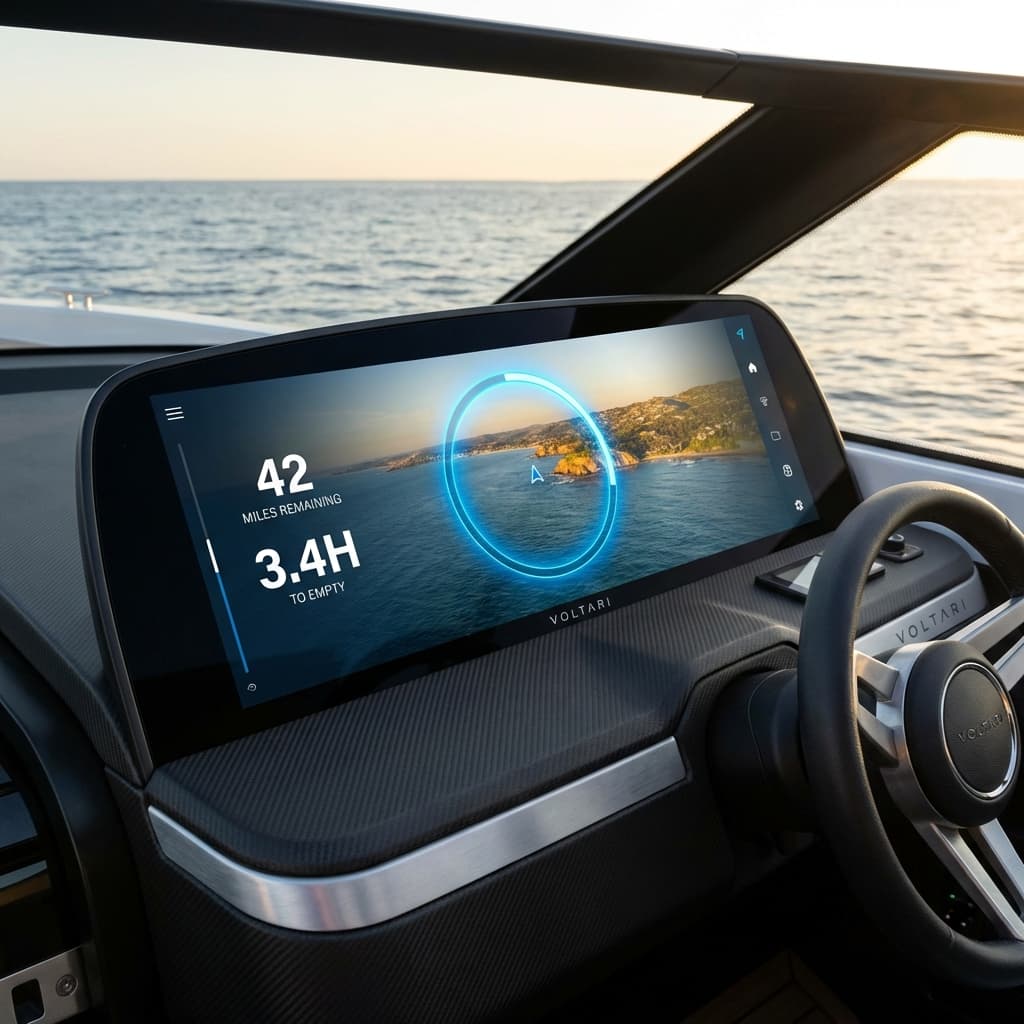
“Do we have enough to get home?” sits under many on-water decisions. With gas boats, the answer can feel fuzzy. A float sender in a moving tank measures fuel level through slosh, trim angle, and tank shape, then turns that into a gauge reading. Owners learn the habits of their boat and treat the needle as a hint, not a number. Many rigs add fuel-flow sensors and chartplotter logic to improve “fuel remaining,” which is a sign that the default system is not trusted.
Electric propulsion changes the starting point. A battery management system (BMS) tracks state of charge, voltage, current, temperature, and pack limits. The motor controller knows power draw at each moment. Put those together with GPS speed over ground, and a boat can compute energy per mile and convert stored energy into remaining distance and time. That is the core of range prediction on electric boats: measure energy with high resolution, measure speed, then project forward.
What matters is not the math. It is the product design choices that wrap the math into decisions a boater can use.
Standard Bearers of Precision
Leading manufacturers are already setting the baseline for how this data is presented.
Torqeedo states the method in plain terms: its onboard computer links motor consumption data with battery charge level and GPS speed over ground to calculate remaining range on an ongoing basis. This is visible on the motor display and in its phone app. When paired with TorqTrac, the range becomes a map feature: a live display of how far you can still travel, plus waypoint planning and ETA. This matters because range is not abstract; it is range to that dock or range back to that ramp.
Mercury takes the same idea into a mass-market outboard experience. The Avator line uses integrated GPS for distance-to-empty estimates on its displays. It extends that into the Mercury Marine app, which presents a GPS map with visualized range estimates for trip planning, along with battery state of charge and performance data. This is the software move that reduces stress: not a percent battery icon, but a picture of where you can go from here.
ePropulsion shows the concept in its own control UI. The display includes a distance readout that can show the remaining distance the outboard can travel. It signals a design pattern: electric systems treat remaining distance as a first-class instrument.
Candela takes a broader platform angle: connected boats, sensors, and fleet data, with a connected-vehicle framing that includes real-time data to improve safety and operations. Even when a brand does not market range prediction as the headline, connected telemetry is the path toward better projection because it allows software to learn how boats behave across conditions and update models over time.
Why the Electric Estimate is More Trustworthy
So is it plausible to argue that electric boats offer more peace of mind than gas boats on the “will we get home” question? Yes, with limits and honest framing.
- The fuel source is measurable with high resolution. Battery current and voltage are sensed and computed by design, because the system must protect the pack. That yields a tight view of energy used.
- The projection can be anchored to your present draw. If you pull back the throttle, the model updates at once. Marine hulls tend to have predictable consumption curves for a given load.
- The UI can show the decision, not the number. Range rings, route overlays, waypoint estimated time of arrival (ETA), and distance-to-empty turn "how much" into "where to."
The "Limp Home" Advantage
The weak link in traditional boating is often the tank level signal. Irregular tank shapes, sender type, installation position, and vessel trim can distort the mapping between level and usable fuel. Many boats rely on a gauge that cannot be fully trusted without calibration tools or fuel-flow integration.
Electric boats offer a “putt along and get home” safety net. Reducing throttle drops the hull onto an efficient displacement zone. Power demand falls fast as speed falls, which yields a sharp jump in remaining time and distance. Range software reinforces that behavior because the display converts that throttle change into updated distance-to-empty and time remaining. That feedback loop can steer people away from high-power decisions that might leave them stranded.
Gas boats can also limp home at low speed, but the confidence gap sits in the instruments. If the gauge is suspect and the burn rate unknown, slowing down feels like guessing. A calibrated fuel-flow system fixes this, but many boats lack it.
"Reducing throttle drops the hull onto an efficient displacement zone. Power demand falls fast as speed falls, which yields a sharp jump in remaining distance."
The Limits of Prediction
Electric range prediction is not magic. Water current, wind, waves, growth on the hull, payload shifts, battery temperature, pack aging, and prop choice all change consumption. GPS speed over ground can mislead when current is strong. The best systems reduce this risk by updating the estimate from live consumption and pairing range with route context so the operator sees the margin.
Summary: Software as Seamanship
The deeper point for the electric-marine story is that software is becoming part of seamanship. It is not only about silent propulsion. It is about instruments that turn energy into decisions, in real time, on a chart, with a margin you can see.
Ready to see the math for your own boating habits? Check out our Marine Cost Calculator to see how electric compares to gas.
Stay in the Loop
Get weekly updates on the latest electric boats, industry news, and exclusive insights.